
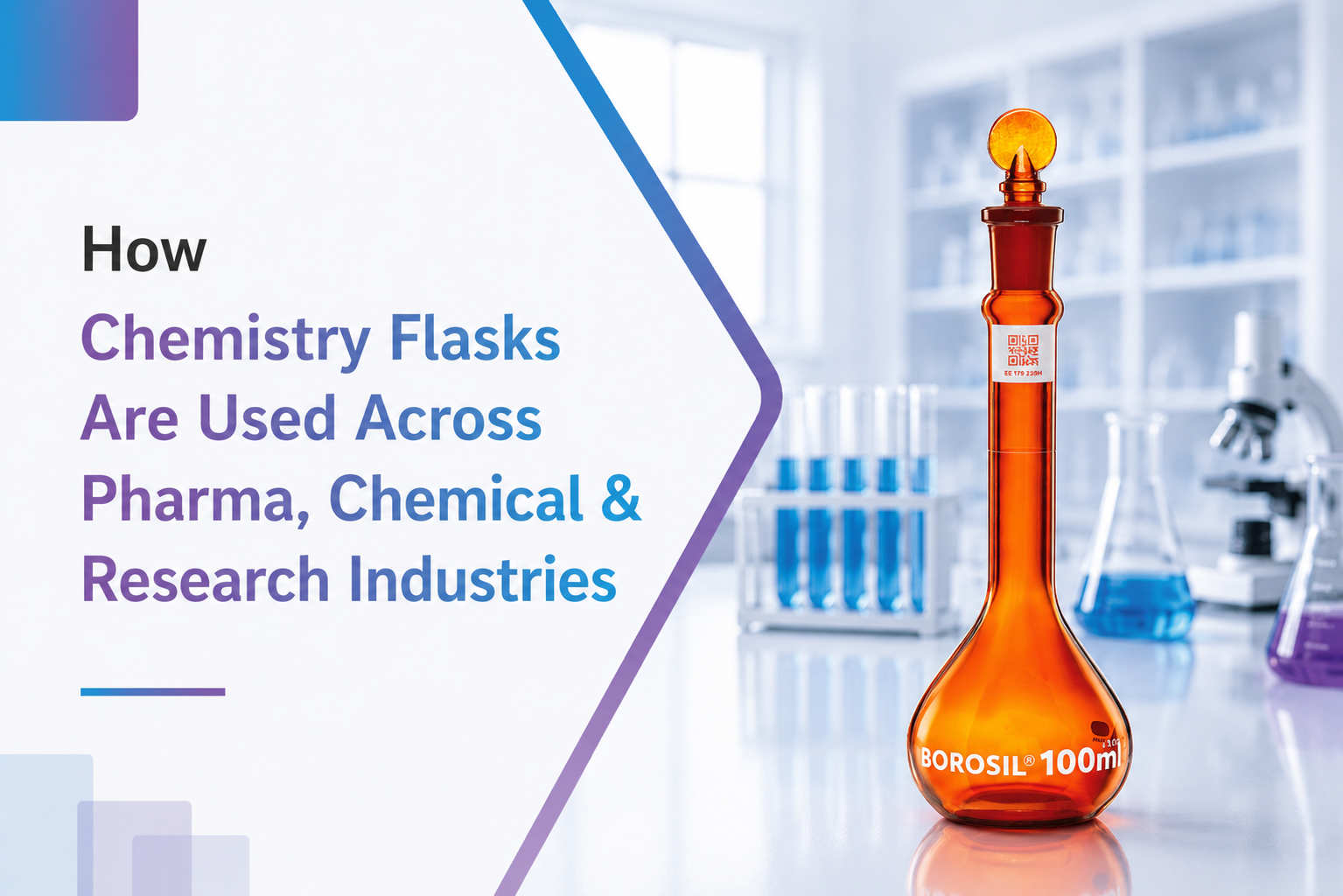
Laboratory glassware plays an important role in scientific work, and the chemistry flask is among the most widely used pieces of equipment. Its design allows researchers and laboratory professionals to mix, heat, store, and prepare solutions for different applications. From pharmaceutical manufacturing to chemical processing and scientific research, different types of flasks support tasks requiring accuracy, consistency, and safe material handling. Selecting the right flask for a particular application helps improve the quality of laboratory work and supports reliable experimental results.
What Is a Chemistry Flask?
A chemistry flask is a laboratory vessel used for mixing, heating, storing, and preparing liquids during scientific experiments and analytical procedures. Unlike standard laboratory beakers, flasks are available in different shapes to suit specific laboratory tasks. Their design helps scientists handle liquids efficiently while supporting accurate solution preparation and safe laboratory practices.
Different flask designs serve different purposes. The conical flask has a narrow neck and a wide base, allowing liquids to be mixed by swirling while helping reduce the risk of splashing. Other common types include volumetric flasks for preparing solutions with precise volumes, round-bottom flasks for heating applications, and filter flasks for vacuum filtration.
Laboratory flasks used for general laboratory applications are commonly manufactured from low-expansion borosilicate glass 3.3, which offers excellent chemical resistance and thermal shock resistance during laboratory work. Manufacturers such as Borosil Scientific produce laboratory flasks made from low-expansion borosilicate glass 3.3 for a wide range of scientific, analytical and research applications.
How Chemistry Flasks Are Used in the Pharmaceutical Industry
Pharmaceutical laboratories rely on laboratory flasks throughout drug development, testing, and quality assurance. Different experiments require different flask designs to maintain accuracy and support standard laboratory practices.
Common applications include:
- Drug formulation:Scientists prepare and evaluate formulations before progressing to larger-scale production.
- Sample preparation:Laboratory personnel dissolve, dilute, and mix samples before analytical testing.
- Quality control testing:Flasks support routine testing of raw materials, intermediates, and finished pharmaceutical products.
- Solution preparation:Standard solutions, reagents, and buffers are prepared using suitable laboratory flasks to ensure consistent concentrations.
Accurate laboratory procedures contribute to reproducible results, making the correct choice of glassware an important part of pharmaceutical operations.
How Chemistry Flasks Are Used in the Chemical Industry
Chemical laboratories perform a wide range of reactions and analyses that require dependable laboratory equipment. Flask selection often depends on the reaction conditions and the characteristics of the chemicals involved.
Typical uses include:
- Chemical synthesis:Laboratory flasks provide suitable vessels for carrying out controlled chemical reactions.
- Mixing reagents:Their design allows efficient mixing while helping minimise liquid loss during swirling.
- Heating applications:Round-bottom flasks and other heating-compatible flask designs promote more uniform heat distribution during laboratory procedures at elevated temperatures.
- Process development:Small-scale laboratory trials help researchers evaluate reactions before transferring processes to larger production systems.
Using the appropriate laboratory flask supports safe handling of chemicals and contributes to consistent experimental conditions.
How Chemistry Flasks Are Used in Research Laboratories
Research laboratories use laboratory flasks across scientific disciplines, including chemistry, biology, environmental science, and materials science. Different projects require different flask designs depending on the experimental objective.
Some common applications are:
- Experimental research:Scientists prepare, combine, and observe materials during investigative studies.
- Method development:Researchers evaluate and refine analytical methods before routine implementation.
- Analytical studies:Laboratory flasks support sample preparation for various analytical techniques.
- Academic laboratories:Educational institutions use laboratory flasks during practical sessions to demonstrate scientific principles and laboratory techniques.
Reliable laboratory equipment helps researchers maintain consistency while repeating experiments and comparing results across studies.
Choosing the Right Chemistry Flask for Different Laboratory Applications
Selecting the right chemistry flask depends on the specific requirements of the experiment rather than on using one design for every laboratory task. Laboratory professionals typically consider factors such as the type of procedure, heating requirements, chemical compatibility, required capacity, and the level of measurement accuracy needed. Evaluating these factors helps ensure that the selected flask supports the intended application and delivers dependable performance throughout the experiment.
Different flask designs are developed for different laboratory functions, so choosing the appropriate one is essential. A flask intended for heating applications may not be suitable for preparing precise standard solutions, while a volumetric flask is designed for accurate volume measurement rather than vigorous mixing. Matching the flask to its intended use supports safer laboratory practices, reduces the likelihood of experimental errors, and contributes to reliable and consistent results.
Conclusion
Chemistry flasks remain an essential part of laboratory work across pharmaceutical, chemical, and research industries. Their different designs support a wide range of scientific activities, from preparing solutions and conducting chemical reactions to quality testing and research. Selecting the appropriate flask for each laboratory application helps improve accuracy, promotes safe handling of materials, and contributes to consistent experimental results. Understanding how different flasks support specific laboratory processes enables scientists and laboratory professionals to carry out their work with greater confidence and efficiency.
