
Introduction
In aerospace and medical manufacturing, complex parts challenge traditional 3-axis machining, causing errors and high costs from multiple setups. A fragmented process is the root cause. This Expert Tech Analysis explores how multi-axis machining solutions enable single-setup completion, scientific Multi Axis CNC Materials selection, and certified precision for higher yield and reliability.
Why is Multi-Axis Machining the Key Technology for Solving Deformation in Thin-Wall and Deep-Cavity Parts?
The limitations of conventional methods are magnified when machining weak, rigid features like thin walls and deep cavities. Excessive tool overhang leads to vibration and tool deflection (“tool push-off”) under cutting forces, while multiple fixturing introduces repositioning errors and clamping stresses, collectively causing uncontrolled part distortion and dimensional inaccuracies.
The Core Principle: Vector Control and Short-Tool Strategy
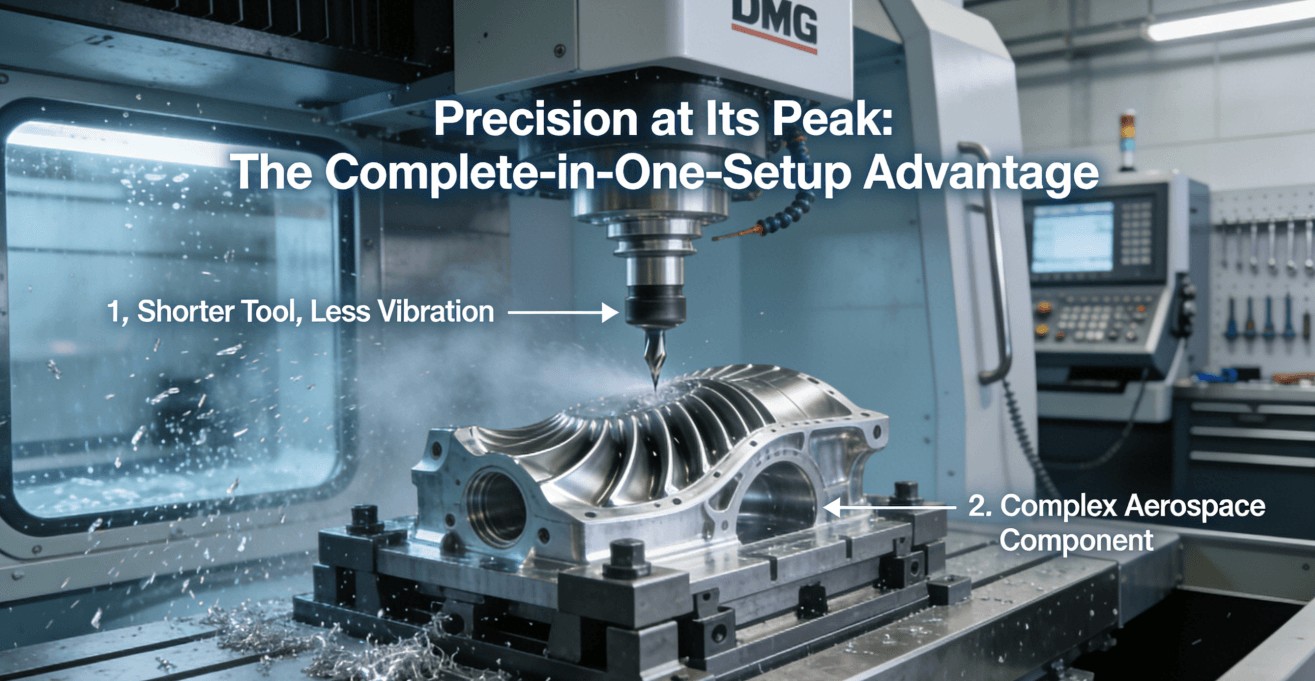
The fundamental advantage of simultaneous Multi Axis CNC Machining lies in flexible tool vector control. The tool’s orientation can be continuously adjusted to keep its axis as perpendicular as possible to the machining surface.
- Enhanced Stability with Short Tools:
For deep cavities, 5-axis machining allows the use of a tool significantly shorter than the cavity depth, approaching and machining side walls laterally. This drastically reduced overhang greatly increases tool rigidity. A Society of Manufacturing Engineers (SME) report on “Tool Dynamics in Advanced Machining” notes that employing a short-tool strategy can improve system stability by over 60%, proving critical for vibration control . - Optimized Cutting Force Direction:
Utilizing the tool’s side-cutting edges while maintaining an optimal engagement angle helps distribute and reduce radial cutting forces, thereby minimizing bending in thin-walled sections.
Achievable Precision and Tolerances
This systematic control over cutting forces and vibration is fundamental to consistently achieving stringent 5-Axis Machining Tolerances (such as ±0.005 mm or tighter). It minimizes distortion factors at the process source, ensuring dimensional uniformity. For complex components involving diverse materials, formulating a scientific multi-material machining strategy is paramount for success.
How to Select the Right Engineering Materials for Complex Multi-Axis Projects?
The material is the vessel of design, and its selection directly determines the final performance, longevity, and manufacturability of a part. A framework based on Expert Tech Analysis must balance functionality, machinability, and cost.
Different materials require vastly different processes within multi-axis machining solutions. Machining titanium alloys necessitates lower cutting speeds and high-pressure coolant to prevent workpiece overheating and work hardening. Conversely, machining PEEK requires precise control of cutting heat to avoid melting and sharp tools to achieve a high-quality sheared surface. Scientific process parameters are essential to unlock material properties and avoid machining defects.
In highly regulated industries, material certification and traceability are as critical as performance. A manufacturer certified to ISO 13485 (Medical Devices) and IATF 16949 (Automotive) signifies a robust supplier management and incoming inspection system, ensuring every material batch complies with specifications and is fully documented. This forms the managerial foundation for achieving high reliability. A partner like JS Precision, holding these certifications, provides this crucial assurance from raw material to finished part.
How Do Programming and Process Optimization for Multi-Axis Centers Impact Total Cost and Lead Time?
Cost Drivers and Key Optimization Levers
The total cost of a multi-axis project includes programming, setup, and scrap costs beyond machine runtime. Here, efficient CAM programming and simulation are key optimization levers. They minimize debug time, prevent errors, and improve machine utilization, directly controlling system cost and ensuring project success.
- Efficient CAM Programming:
Reducing expensive machine debug time is critical. Advanced simulation prevents costly collisions. - Intelligent Process Simulation:
Virtual verification optimizes toolpaths and cutting loads, boosting machine utilization and lowering per-part cost.
Technology Integration for Accelerated Delivery
Modern 5 axis CNC machining centers integrate multiple operations in one setup. This eliminates secondary handling, reducing errors and cycle times by over 40%, as noted in VDMA studies. Partnering with an expert in 5 axis CNC machining services is thus vital for efficiency.
What Role Do International Certifications (e.g., AS9100D, ISO 14001) Play in Ensuring Consistent Machining Quality?
Achieving consistent, high-precision output requires not only top-tier Multi Axis CNC Machining equipment but also a mature, traceable quality management system. International certifications are authoritative proof of this system’s effective operation.
Certification frameworks move quality control from “inspection of results” to “prevention in the process.” AS9100D (Aerospace Quality System) emphasizes risk management and full product traceability, requiring verification for every step from raw material to final product. ISO 9001 mandates process approach and continual improvement principles, ensuring operational standardization and consistency.
These requirements materialize in every step of precision machining: from mistake-proofing verification in programming based on 3D models, to comprehensive dimensional First Article Inspection (FAI) reports; from periodic in-process checks (IPQC) and tool life management during machining, to final inspection before shipment per standards. A certified system ensures that regardless of order size or part complexity, control standards remain consistent, enabling the stable achievement of promised precision metrics and yields exceeding 99%. Furthermore, certifications like ISO 14001 demonstrate a manufacturer’s commitment to sustainable manufacturing.
What Are the Unique Challenges and Solutions for Aerospace vs. Medical Applications in Multi-Axis Machining?
While both rely on high-precision multi-axis machining solutions, the aerospace and medical industries have different priorities for parts, facing distinct challenges and employing specialized solutions.Challenges stem primarily from “difficult-to-machine materials” (like Inconel super alloys) that are strong with low thermal conductivity, and complex thin-wall structures for extreme weight reduction. Solutions focus on “taming” the material: employing high-pressure through-tool coolant (over 1000 psi) to remove heat and break chips; using specialized tooling with specific coatings (like AlTiN) for enhanced wear resistance; and applying adaptive milling strategies that adjust feed based on actual cutting load to protect the tool and work piece.
Challenges involve meeting stringent biocompatibility regulations, achieving damage-free fixturing (especially on polished surfaces), and attaining ultra-smooth surfaces (Ra < 0.2 µm) to inhibit bacterial colonization. Solutions revolve around “cleanliness” and “precision”: using medical-grade fixtures or custom work holding for mark-free clamping; employing Minimum Quantity Lubrication (MQL) or dry machining to avoid contamination; and mandatory post-processing like electro polishing to remove micro-scratches, reduce roughness, and form a passivation layer.
A proficient provider of 5 Axis CNC Machining Services must offer differentiated process packages for these industries. This could mean designing specialized anti-vibration fixtures and high-pressure coolant interfaces for aerospace parts, or establishing a separate clean production area and performing stringent cleanliness checks for medical implants. This deep customization based on industry knowledge is the true value of multi-axis machining solutions.
Conclusion
In summary, elevating the yield and reliability of complex components to industry-leading levels is not achievable through a single technological breakthrough. It is a systems engineering feat that deeply integrates advanced Multi Axis CNC Machining technology, scientific material and process selection based on Expert Tech Analysis, and a full-process quality management system governed by international certifications like AS9100D and ISO 9001. This trinity of “Technology-Management-Standards” constitutes the core competitiveness of modern precision manufacturing.
If you are seeking a reliable manufacturing solution for a challenging complex part and expect consistently high yield with transparent process control, obtaining a professional manufacturability analysis and quote is the definitive first step toward success.
Author Bio
This article shares technical perspectives from a manufacturing engineer with over 15 years of experience in the precision manufacturing sector. The views are based on long-term observation and practice in multi-axis machining technology and industrial quality systems.
FAQs
Q1: What is the main advantage of multi-axis CNC machining compared to 3-axis machining?
A1: The core advantage is the ability to complete complex geometries in a single setup, eliminating repositioning errors and significantly improving accuracy and consistency. It is especially suitable for parts with curved surfaces, angled holes, or deep cavity features and can reduce total machining time by over 30%.
Q2: My part involves both metal and plastic components. Can multi-axis machining handle this multi-material need?
A2: Yes. Advanced multi-axis machining centers, coupled with professional process planning, can efficiently handle multi-material assemblies. The key lies in upfront Expert Tech Analysis to develop matched cutting parameters, tooling, and fixturing plans for different materials, ensuring overall assembly accuracy.
Q3: When selecting a 5-axis CNC machining service, besides price, what other aspects of a supplier should be prioritized?
A3: Key areas to evaluate include their technical portfolio (especially parts of similar complexity), quality certifications (e.g., ISO 9001, AS9100D), inspection equipment (like CMM), and whether they provide detailed DFM (Design for Manufacturability) feedback. These factors are more indicative of final outcome quality and total cost than the initial quote.
Q4: How can high precision be maintained for small-batch, highly complex multi-axis machined parts?
A4: It relies on strict process discipline and a First Article Inspection (FAI) regime. Even for small batches, standardized machining programming, tool management, and comprehensive FAI using CMM ensure that dimensions and tolerances meet stringent 5-Axis Machining Tolerances requirements from the first piece to the last.
Q5: For ultra-high-demand parts like medical implants, how does multi-axis machining ensure biocompatibility and surface integrity?
A5: It involves using medically certified materials and lubricants throughout the process, employing stress-free fixturing and optimized cutting parameters to minimize the heat-affected zone. Post-machining, special treatments like electropolishing are mandatory to achieve an ultra-smooth surface of Ra<0.2µm, eliminate micro-cracks, and ensure biocompatibility.
